Read more of this story at Slashdot.
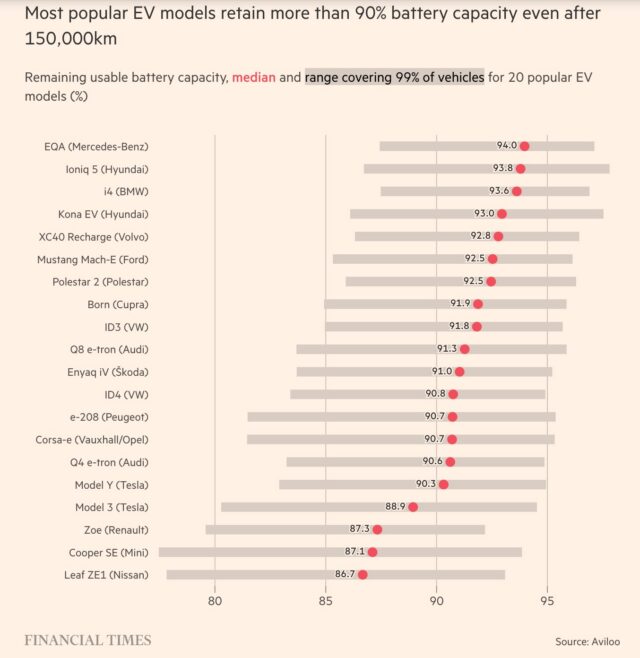
Electric vehicle batteries are lasting longer than previously feared by drivers, with most used EVs able to retain about 90 percent of their original usable battery capacity after 150,000 kilometers, a new study has shown.
Despite a surge in global EV sales on the back of rising fuel prices, long-term battery durability continues to be one of the key concerns for drivers when they consider switching from a petrol model to an electric car.
EV battery warranties typically cover eight years or 100,000 miles (160,000 km) with car manufacturers required under the warranty to provide a replacement battery if capacity falls below 70 percent.
According to the latest study published by Aviloo, an Austria-based group that analyzes battery health, the median state of health (SoH)—which represents the remaining percentage of a battery’s original usable capacity—for 20 popular EV models stood between 87 percent and 94 percent after 150,000 km.
The median SoH was between 91 and 97 percent after 50,000 km, and 88 and 95 percent after 100,000 km. The study was based on more than 500,000 tests Aviloo carried out globally on the 20 EV models including Tesla’s Model Y and Volkswagen’s ID.4 between 2022 and 2026.
Credit:
Aviloo/Financial Times
The Aviloo study, which did not include Chinese models due to lack of data, also showed that the speed of battery degradation varied significantly even within the same EV model depending on climate conditions, battery size, and driver habits, such as parking.
“In contrast to a combustion engine car, where age and mileage would more or less carry the value of the car and technical condition, that’s not the case for an EV,” said Marcus Berger, chief executive of Aviloo. “The car might look the same—same age, same mileage—and you don’t know how it has been treated.”
For Nissan’s Leaf ZE1 model, which requires more frequent charging to cover the same distance than other EV models due to the smaller size of its battery, the median SoH at 150,000 km varied by as much as 13.5 percentage points—equivalent to about 29 km of real-world range per charge and the largest spread among the 20 EV models covered by the study.
Aviloo said the spread between the individual cars could vary by up to 11 percentage points for Tesla’s Model Y, 11 and 12 points for VW’s ID.4, and more than 12 points for Hyundai’s Ioniq 5.
Berger said batteries of EVs in hotter climates degraded faster, while another key factor was how much the batteries were charged when the EVs were parked. “What very few consumers know is: don’t park your cars with 100, 90, or 80 percent state of charge. It’s just harming the battery,” he said, adding that the ideal level was between 30 and 70 percent.
Aviloo’s study came as three of the UK’s largest EV organizations recently called on the government to introduce mandatory battery health certifications to boost confidence for buyers and reward owners who have properly maintained their vehicles.
“We see the customer demand for confidence in battery health,” said James Strong, used-car sales and delivery manager at Tesla UK, adding that “a nationally recognized battery state of health standards” would strengthen confidence in the used EV market and improve transparency for consumers.
© 2026 The Financial Times Ltd. All rights reserved. Please do not copy and paste FT articles and redistribute by email or post to the web.
Read more of this story at Slashdot.
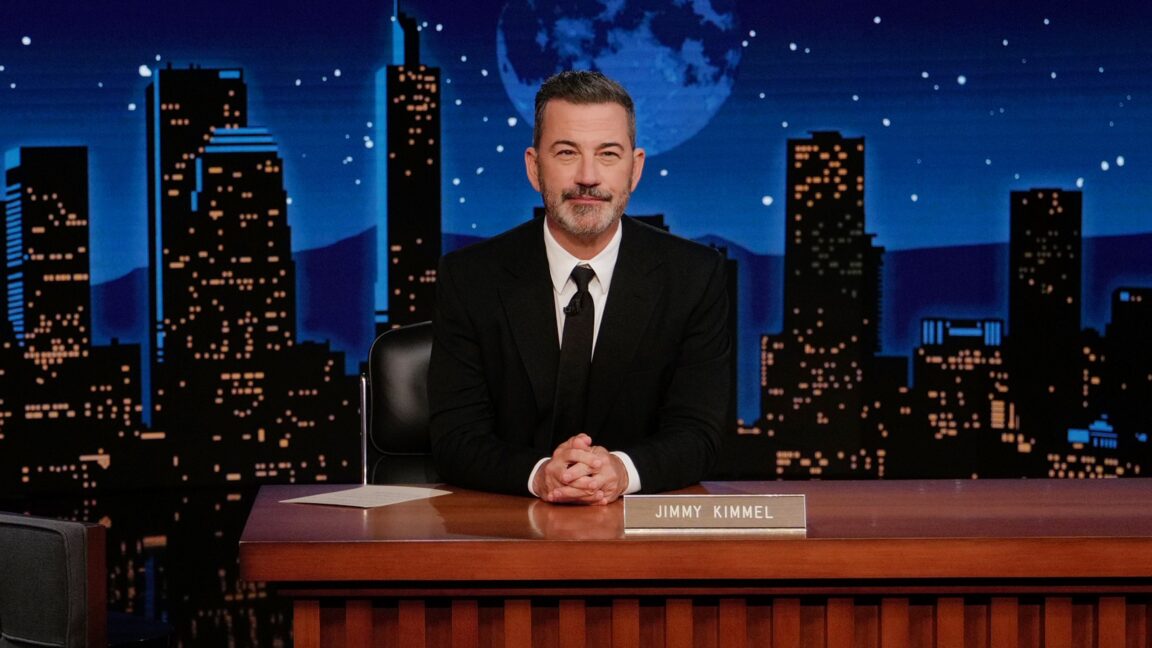
ABC's Jimmy Kimmel said he will be interviewing a Democratic candidate for Senate tonight, but the interview will be on YouTube only and not broadcast on TV because of threats made by the Federal Communications Commission.
Kimmel has been a prime target in the Trump FCC's attacks on ABC and its owner, Disney. In his monologue last night, Kimmel said he'll be interviewing Democrat James Talarico, a state representative who is running against Texas Attorney General Ken Paxton for a seat in the US Senate.
In previous years, such an interview would have aired on the broadcast show via local stations throughout the country, Kimmel said. This time, it will only be on the Jimmy Kimmel Live YouTube channel in order to prevent further trouble for individual stations that hold FCC licenses, he said.
"I'll be interviewing James Talarico tomorrow night under unusual circumstances," Kimmel told the audience on Wednesday. "For a lot of years, for the whole 20-plus years of our show, in fact, I've been interviewing Americans who are running for office with no problem at all, just like Letterman did, Leno did, Arsenio, et cetera, et cetera. I've interviewed a lot of political candidates, from Hillary Clinton to Ted Cruz to Donald Trump himself."
But as Kimmel said, "something has changed." Disney suspended Kimmel briefly last year after FCC Chairman Brendan Carr threatened to revoke the licenses of ABC stations for "news distortion" if they continued to air Kimmel's show.
Much more has followed. In April, the Carr FCC ordered an early license review for all eight TV stations owned by ABC. Carr did this only one day after Trump and first lady Melania Trump called on ABC to fire Kimmel over a joke they didn't like, though the FCC says the license review is over allegations that ABC’s diversity, equity, and inclusion (DEI) practices violate anti-discrimination rules.
The Carr FCC also started investigating ABC's The View after it aired an interview with Talarico and opened a proceeding in May 2026 to examine whether The View should continue to be exempt from the equal-time rule as a “bona fide news interview program.” The View hasn’t aired any interviews of political candidates since the FCC began the proceeding.
Until Carr took over at the FCC, the agency historically treated talk shows that feature interviews as exempt from the equal-time rule that requires stations to provide comparable time and placement to an opposing candidate if an opposing candidate makes a request. The Carr FCC ordered broadcast TV stations in January to comply with the equal-time rule when airing late-night and daytime talk shows that are "motivated by partisan purposes," but has not made similar moves against talk radio shows that are predominantly conservative.
“Jimmy Kimmel’s decision to keep his interview with a Senate candidate off the air shows just how far this administration’s campaign of censorship and control has gone," FCC Commissioner Anna Gomez, the commission's only Democrat, said today. Gomez said the FCC "has no lawful authority to threaten broadcast licenses over guest bookings or editorial decisions," and that "no host, local affiliate, or network should have to weigh federal retaliation before booking a guest for a newsworthy interview. Any attempt to pressure broadcasters into self-censorship undermines both press freedom and the public’s right to hear from candidates in their communities seeking public office."
An interview with Talarico was also at the center of controversy in February when Stephen Colbert said CBS forbade him from interviewing the candidate. Colbert put the interview on YouTube instead. CBS denied prohibiting the interview but said it gave Colbert “legal guidance that the broadcast could trigger the FCC equal-time rule for two other candidates... and presented options for how the equal time for other candidates could be fulfilled."
Disney sued the FCC in August, saying its First Amendment rights have been violated and that "ABC must now evaluate any invitation to a political candidate for its potential consequences, including whether it might later be cited by the Commission as a basis for non-renewal in the Stations’ impending license renewal proceedings.” Disney said the Trump administration’s campaign of censorship against ABC will be particularly damaging during the months before the midterm election.
Kimmel didn't recount all of that history last night, but referred to it when he told the audience about the upcoming Talarico interview. Kimmel said:
I interviewed Donald Trump when he was running for president in 2015, and at that time when he was the one sitting next to me, he seemed to have no problem with the idea of talk show hosts interviewing candidates. In fact, he was very eager to come back for another interview, which he did just before he became the nominee in 2016.
But for some reason, and I can't seem to figure out what that reason is, something has changed. Now that he's president, his FCC has threatened me, threatened our show, threatened our network, ABC, our affiliates, our local stations, based on simple, traditional editorial decisions, guest bookings it would seem they don't like.
Kimmel said the decision to put the interview on YouTube was made out of consideration for local stations that could face FCC threats to their broadcast licenses.
"And so out of consideration for our local stations, especially our ABC affiliates in Texas who would have to deal with this nonsense, my interview tomorrow with James Talarico will not air on television," Kimmel said. "It will be posted on YouTube instead. It will not be on TV. So if you want to learn about a candidate for the Senate tomorrow, you will have to go to the Jimmy Kimmel Live YouTube channel where you will see it in its entirety, and thank goodness we have that because in the America we live in right now, that is the best that we can do, until November, of course."
Disney's legal fight against the FCC is ongoing. The FCC last week urged a court to dismiss Disney's lawsuit and let it continue a proceeding that could end in the nonrenewal of broadcast licenses held by ABC-owned stations. Watchdog groups told the court they are worried that Disney will agree to a settlement with the FCC that "limits the content provided by the ABC stations."
Read more of this story at Slashdot.